Medical simulator specializing in endoscopic catheterization
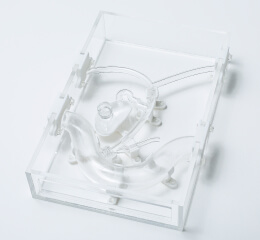
The "ERCP Simulator" is designed based on human body data measured by medical CT and manufactured by
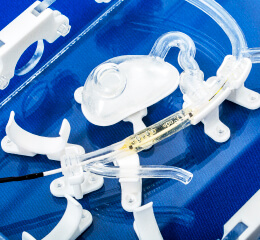
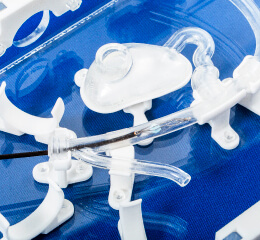
3D printer. The model faithfully reproduces the structure from the duodenum to the right and left
hepatic ducts, and allows for simulation and training of various ERCP procedures. The model is divided
into five parts: duodenum, farter papilla, common bile duct, gallbladder duct and gallbladder, and left
and right hepatic ducts.
ERCP (retrograde cholangiopancreatic ductography with endoscopy)
The digestive tract is an organ that connects the mouth to the anus and is responsible for the intake
and breakdown (digestion) of food.
ERCP is an acronym for "Edoscopic Retrograde Cholangiopancreatography". The endoscope is inserted
through the mouth and advanced through the esophagus and stomach to the duodenum, and a thin catheter is
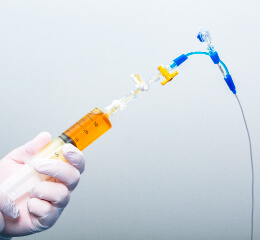
inserted retrograde directly into the bile and pancreatic ducts to inject contrast media and take images
for detailed examination and treatment of abnormalities in the biliary and pancreatic ducts. In
addition, since the diameter of the area beyond the Farter's papilla is too narrow to allow the
endoscope to proceed normally, a contrast medium is used to extract images of the travel.
The JMC
Lab's ERCP simulator is a device that can perform these simulations and training in advance.
Corresponding simulation and training
- contrastography
- EST (endoscopic papillary sphincterotomy)
- EPBD (endoscopic papillary balloon dilation)
- Duodenal stenting
- Bile Duct Stone Removal
- Bile duct stenting
Advantages of using ERCP simulators
Example of ERCP simulator use
Contact Us