Cranial Reconstruction Simulation Model
The hardness of the skull is generally said to be equivalent to that of a pumpkin,
and it can be deficient due to trauma or exenteration. In order to protect the brain, which is the
most important organ in the human body, it is necessary to create a new skull.
Bone reconstruction can be done by transferring bone from another part of the patient's own body, or
by using artificial bone such as titanium or hydroxyapatite. For preoperative simulation of the
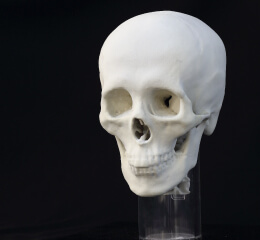
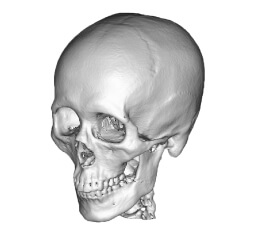
reconstruction, it is useful to use a 3D printer to create a full-scale model from CT data of the
actual skull, and perform model surgery.
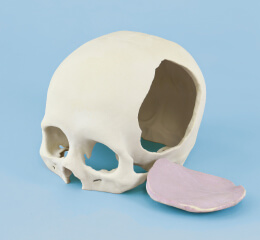
For example, in the case of brain tumors, resection and reconstruction are performed at the same time,
and in the preoperative simulation, it is possible to actually check the joint between the patient's
skull model and the artificial bone part.
Advantages of Using 3D Printers
in Cranial Reconstruction Simulation
Models
The process can include osteotomy, drilling, fixation, and placement of autogenous bone or artificial
bone and osteosynthesis material (implant plate).
-
Shorter treatment time
-
Improvement of
treatment accuracy
-
Reducing the burden
on patients
-
Improvement of techniques
Main uses
- Preoperative simulation
- Confirmation of procedures and treatment plans
- Training of trainees and students
- Development tools, sales tools, and marketing tools for medical device
manufacturers
Contact Us